
An artist based in Argentina
Marina Soria (Mentor)
Born in Buenos Aires, Argentina in 1961, Marina Soria is a seasoned artist and educator. With degrees in Fine Arts and Graphic Design, she lectured for many years on Graphic Design and Editorial Design in the University of Buenos Aires, and later on as an Associate Professor in Typography. Marina is a recipient of numerous awards, has exhibited internationally, and her works are in public and private collections around the world.
HIGHLIGHTS
Her works are at the Contemporary Museum of Calligraphy in Moscow, the Hans-Joachim Burgert´s Collection in Berlin, the Klingspor Museum and the Hoefer Archive in Offenbach, the Arezzo Public Library, the Latin American Collection for the Yale University, Universities and Colleges of Art in the USA such as Dayton, Baylor, Savannah & Otis, as well as the Harrison Collection at the San Francisco Public Library and the Letterform Archive, and amongst other private collections around the world.
Published articles in magazines, Letter Arts Review Annuals, Bound & Lettered Vol 7:2 (USA), Novum 9:2011 (Germany), The Edge 26:1 (UK) as well as Argentine magazines and calligraphy guild association issues around the world. In 2013, her work was extensively featured in LAR 26:3 and in 2021 in LAR 35:2
Works for Symbiosis V Exhibition
*Click on the thumbnail(s) to discover each artwork in detail.
ARTIST | Marina Soria
BASED IN | Argentina
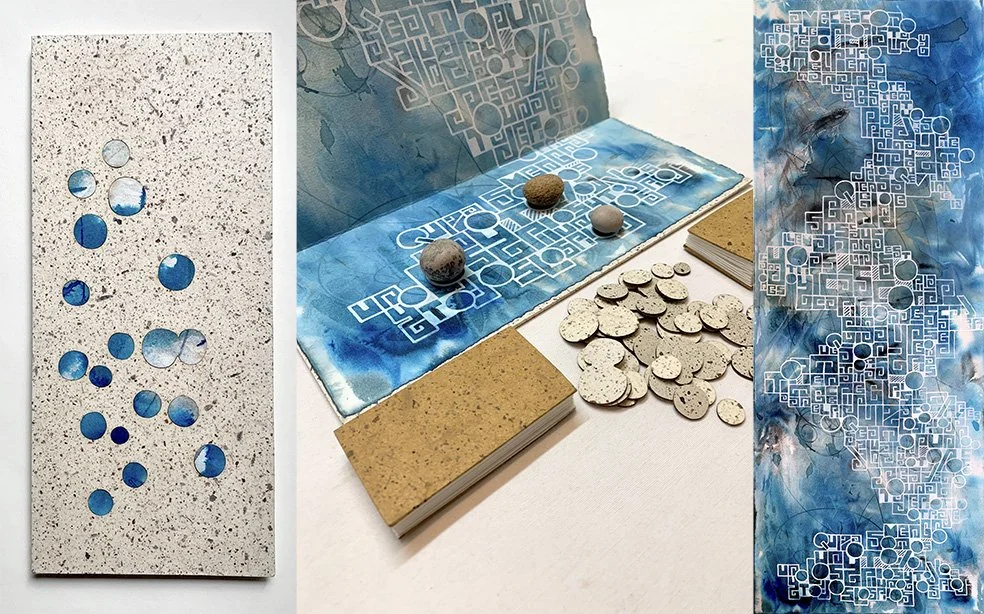
TITLE | SIGNOS · SIGNS
SIZE | Book displayed 1140 x 575 mm / closed 195 x 575 mm
MEDIUM | Warp faced pattern stripes handwoven Aguayo (carrying cloth) made from Alpaca wool; Silkscreen print by Enrique Cambón; Gouache on Rives BFK 100% cotton paper; Binding by Diego Ismael; Linen fabric, metal rings, and wooden stick
PRICE | Not for sale
The text in Spanish belongs to the famous argentine historian in Andean Textiles, Ruth Corcuera, in the book "Teleras, Memory of the Quichua mount". Arte Etnico Argentino editions.
“Thousands of years ago, when only the voice recorded small and big events of everyday life,
women would cover their newborn child in a wrap. In this we see a space created between the mother´s womb and the world outside. We believe textiles were born from such gestures,
within the realm of feelings and from a women´s view: to protect, to give warmth and to sustain life.
In time, textile art will be the means to tell us through colors and designs that the world can be read through symbols, as in a written text.
In the great American cultures these symbols were a kind of lingua franca and textiles a major art with many roles, among them to express that where words did not suffice“